What is Apex Trader Funding?
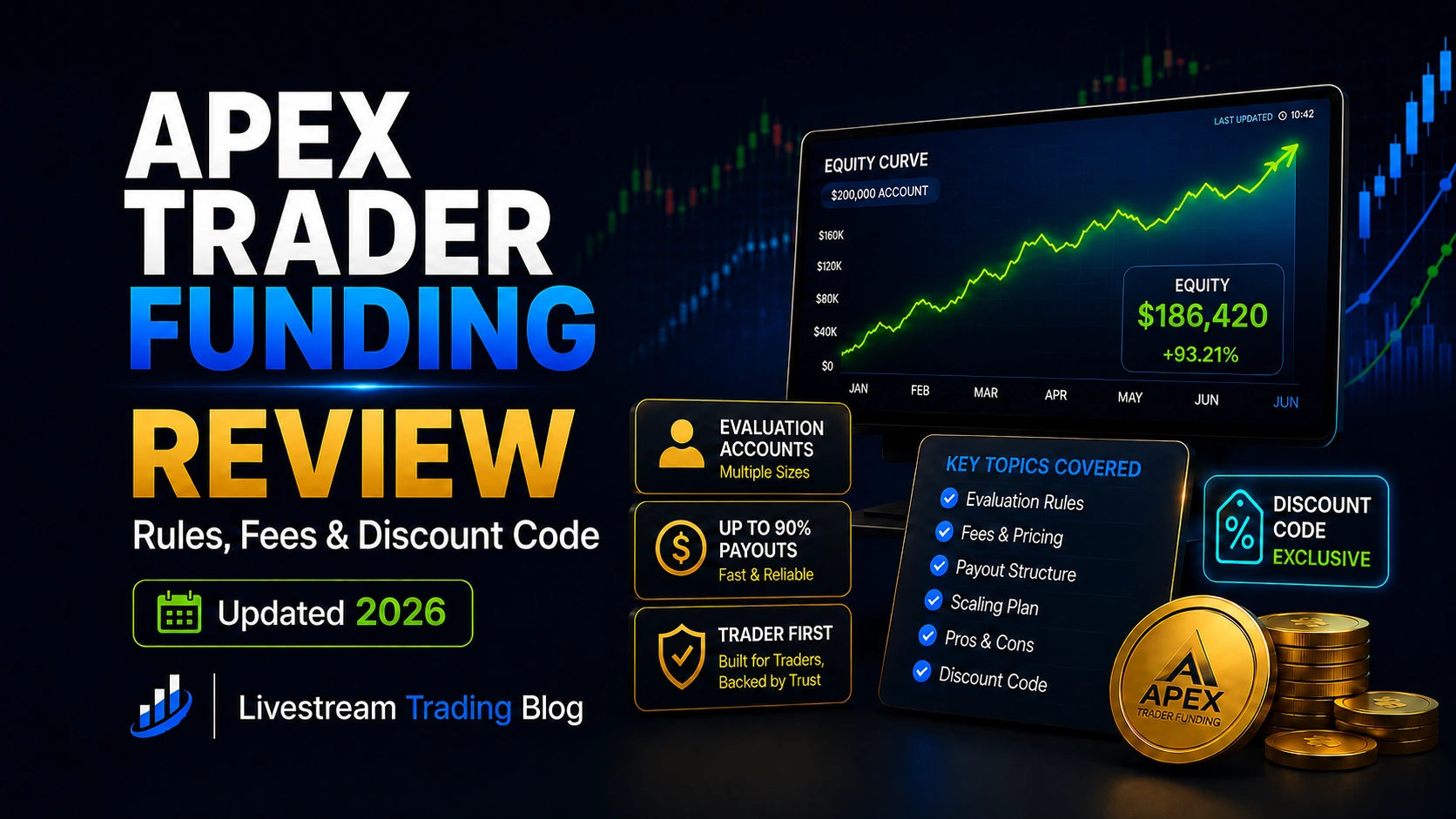
Apex Trader Funding is one of the most popular prop trading firms in 2026. They offer traders a fast track to a funded trading account without risking any personal capital. Apex funds traders who demonstrate profitability by passing a one-time evaluation account while following their risk management rules.
After passing the evaluation account phase, which can be done in a single day (if you have the skills), you are eligible to receive payouts on profits earned with no upfront risk or capital deposit required.
In this updated Apex Trader Funding review, we’ll cover exactly how the program works, the evaluation rules you need to follow, how payouts work, and tips to pass your evaluation.
SAVE UP TO 90% WITH COUPON CODE: LIVESTREAM
Is Apex Trader Funding Legit?
Based on my experience using Apex evaluations and Performance Accounts, Apex is legitimate and well established. They offer payouts for profits earned, and are best suited to disciplined futures traders who want affordable access to multiple accounts and can follow simple rules with good trading habits.
| Current Discount | Up to 90% off |
|---|---|
| Coupon Code | LIVESTREAM |
| Markets Available | Futures (ES, NQ, YM, RTY, etc) |
| Evaluation Types | End-of-Day and Intraday Drawdown |
| Evaluation Access | 30 calendar days to pass |
| Evaluation Billing | One-time payment with no automatic renewal |
| Minimum Time to Pass | As little as one trading day |
| Performance Accounts | Simulated funded accounts |
| Payout Split | 100% of approved payouts on current account products |
| Payout Availability | Up to weekly after meeting the applicable requirements |
| Maximum Active PAs | 20 Performance Accounts |
Account rules vary between End-of-Day, Intraday and Legacy products. Always confirm the rules for the specific account you purchase.
Who is the Apex Trader Funding Program For?
The Apex Trader Funding program is built for both aspiring and experienced day traders who want to scale their market exposure without risking substantial personal capital.
While I think the model has benefits for both beginners and experienced traders, for newer traders it offers an extremely affordable path to institutional-grade platforms, real-time market data, and large account allocations for a one-time evaluation fee. For seasoned professionals, it provides the massive buying power required to scale a proven trading methodology across up to 20 accounts simultaneously using a trade copier.
This funding program is an ideal fit for:
- Under-capitalized traders who need immediate access to professional software, live data feeds, and robust simulated capital without recurring fees (included for free with all account purchases).
- Experienced professionals looking to multiply their returns by mirroring trades across a diversified network of accounts.
- Performance-driven individuals who want to secure reliable, consistent cash payouts based entirely on their trading skills.
- Risk-conscious market participants who prefer limiting their personal financial liability strictly to affordable evaluation and activation fees.
Why Trade with a Prop Firm Instead of Direct Brokerage?
The primary advantage of a futures prop firm over a traditional brokerage account is the complete elimination of personal capital risk. Instead of depositing thousands of dollars into a personal margin account (where a volatile market event could trigger catastrophic losses or margin calls), your maximum financial exposure is strictly capped at the affordable cost of your evaluation and Performance Account activation fees.
You are never liable for trading losses generated inside the account - yet you still receive payouts for profits you generate. If you blow an account or fail an evaluation, your downside is legally protected, and you can simply reset or purchase a new account to try again. Once you hit your profit targets under these safe parameters, you earn identical cash payout opportunities on your returns without ever exposing your financial livelihood to the open market.
In my early years of trading, I experienced firsthand the stress of managing a personal brokerage account during high-volatility news events and markets. Transitioning to a prop firm completely removed that psychological burden; knowing my maximum downside was strictly capped allowed me to trade my best by executing setups with pure mechanical focus and less emotion.Apex Account Types Explained: EOD vs. Intraday
💡 What is Drawdown?
In prop trading, drawdown is the maximum amount of money your account is allowed to lose from its highest profit peak before you fail the evaluation. Think of it as a moving risk ceiling that tracks your performance to ensure you practice proper risk management.
Apex Trader Funding offers two primary account structures depending on your specific trading style. The core difference between an End-of-Day (EOD) account and an Intraday Trailing account is simply when that drawdown risk ceiling moves higher as you secure open profits.
| Feature Parameter | End-of-Day (EOD) Accounts | Intraday Trailing Accounts |
|---|---|---|
| When Drawdown Updates | Only at market close (4:49 PM EST) | In real-time as the trade ticks higher |
| Unrealized Profit Impact | Ignored during the live trading session | Pulls drawdown up at the peak of the trade |
| Daily Loss Limit | Yes (Hard daily stop cap per account size) | No (Trailing drawdown is the main risk limit) |
| Best Suited For | Volatility traders, trend traders, and high-duration holds through micro pullbacks | Scalpers using tight stops and fast targets |
When I first started testing these platforms, the intraday trailing drawdown was an absolute mental trap—I watched perfectly green trades pull back slightly and violate the rules. I exclusively trade and recommend the End-of-Day (EOD) accounts now because they give my positions room to breathe without punishing intraday fluctuations.
1. End-of-Day (EOD) Drawdown (Highly Recommended)
EOD accounts are the most popular option because the maximum trailing risk threshold only recalculates using your final closing account balance at the end of the trading session. If you enter a trade, go up $2,000 in open profit, and later give back that gain before closing the trade at breakeven, your drawdown level does not move. This structure gives your open positions maximum breathing room to fluctuate normally during the market session.
2. Intraday Trailing Drawdown
Intraday accounts track your balance in absolute real-time, including unrealized peak profits from trades that are still open. If your open position reaches a peak profit of $1,500 before pulling back to hit a $500 profit target, your drawdown line permanently trails upward based on that $1,500 high-water mark. This means you can easily fail an intraday account even on a winning trade if you let open profits pull back significantly.
Which Apex Account Type Is Best?
For 95% of traders, the End-of-Day (EOD) Drawdown account is the superior choice. It eliminates the psychological stress of "unrealized profit tracking" and prevents your trailing threshold from locking you out during standard intraday pullbacks. Only select Intraday accounts if you are a fast-execution scalper who exits positions immediately at defined targets without letting profits pull back.
Apex Trader Funding Plans
Apex Trader Funding offers multiple evaluation account sizes to fit every trading style and experience level. The comparative matrix below outlines the baseline contract rules, profit targets, and trailing risk parameters for each available plan tier.
Personally, I find the $50K account offers the absolute best balance between flexibility, affordability, and overall value. The drawdown cushion is manageable, and the profit targets are highly realistic if you trade consistently.
In addition to that, during 90% off promotions you can secure the flagship $50,000 evaluation account for as little as $24 which is all-inclusive with real-time market data feeds and premium platform and charting licenses with no recurring fees.| Account Size | Max Contracts | Profit Target | EOD Drawdown |
|---|---|---|---|
| $25,000 | 4 Positions (40 Micros) | $1,500 | $1,000 |
| $50,000 Popular | 6 Positions (60 Micros) | $3,000 | $2,000 |
| $100,000 | 8 Positions (80 Micros) | $6,000 | $3,000 |
| $150,000 | 12 Positions (120 Micros) | $9,000 | $4,000 |
Apex Evaluation Rules (2026): How to Pass
Passing an Apex evaluation is relatively straightforward: reach your account's profit target while staying within its risk limits.
Both End-of-Day (EOD) and Intraday evaluations follow essentially the same rules. The main difference is how your maximum drawdown is calculated, which we've covered above.
✅ Apex Evaluation Rules at a Glance:
- 30 Days to Pass: You have 30 calendar days to reach your profit target. Evaluations are one-time purchases with no recurring billing, and failed or expired accounts must be repurchased.
- Pass in Just One Day: There are no minimum trading day requirements. If you reach your profit target in a single session without violating any rules, you've passed!
- No Consistency Rule: Unlike Performance Accounts, evaluations don't require you to spread your profits across multiple days.
- Respect Your Drawdown Limit: Touching your account's maximum drawdown threshold results in a failed evaluation, regardless of how much time you have remaining.
- Position Limits: Stay within the maximum number of contracts permitted for your account size, as outlined in the table above.
- No Hedging or Overnight Positions: Hedging positions across accounts is prohibited, and all trades must be closed before 4:59 PM Eastern Time.
One important distinction: EOD evaluations have a separate Daily Loss Limit. For example, the $50K EOD account has a $1,000 daily loss limit. Hitting it pauses trading for the day but doesn't automatically fail your evaluation. Intraday evaluations don't have a separate daily loss limit.
My take: I appreciate that Apex doesn't impose minimum trading days or consistency requirements during the evaluation. You're free to trade your strategy, wait for quality setups, and reach the profit target at your own pace within the 30-day window.
What Happens After you Pass the Evaluation?
Once you hit your profit target for the evaluation account your dashboard will officially update to show you've passed after the market closes for the day. You'll then get an email with a link to activate your new Performance Account (PA), which comes with a fresh starting balance and is fully eligible for payouts going forward.
Just keep in mind that you have a maximum of seven calendar days from the time you pass to log into your Apex dashboard and complete this setup process. It's a quick, straightforward transition, and once your PA profile is active, you are ready to start trading for real payouts.
Apex Performance Account Rules
Once you've passed the evaluation (don't worry if it takes more than one try, many people need to do multiple accounts before developing the strategy to pass), current EOD and Intraday Performance Accounts introduce several rules that are not applied during the evaluation:
Tier-Based Scaling
Traders do not begin a PA with the maximum advertised contract size. Position limits and Daily Loss Limits increase as the account reaches higher end-of-day profit tiers. This is a good thing - it prevents you from betting too big on your new payout eligible account and promotes trading with consistency and a professional attitude - which is what professional traders do.
For example, a $50K PA begins at:
- Level 1: Two standard contracts are the max size you can trade with a $1,000 Daily Loss Limit
- Level 2: Three contracts max can be traded after reaching $1,500 in profit
- Level 3: Four contracts max can be traded after reaching $3,000 in profit
- Level 4: Four contracts and a $3,000 daily loss limit after reaching approximately $6,000 in profit
The assigned tier is determined from the prior session’s end-of-day balance and does not change intraday.
Daily Loss Limit
Both new EOD and Intraday Performance Accounts have tier-based Daily Loss Limits or "DLL".
Reaching the DLL automatically liquidates open positions and pauses trading for the rest of the session. It does not permanently close the PA. The account becomes tradable again at the next session open. This is common practice in prop firms to protect your profits when you're not having a good trading day.
Maximum Number of Performance Accounts
Apex allows a maximum of 20 active PAs across the trader’s household, personal account, business account, platforms and connections. More on copy trading later in the article.
Dollar Cost Averaging is Allowed
As of 2025, DCA (dollar-cost averaging) is now allowed in funded accounts. You can add to a losing trade, provided you remain within the daily max loss and drawdown rule for the account type.
Apex Trader Funding Payout Rules, Profit Split, and Withdrawals (2026)
Once you pass your evaluation and activate your Performance Account (PA), you can become eligible to receive cash payouts from your simulated trading profits. Apex's current EOD and Intraday Performance Accounts offer a 100% payout split on approved withdrawals, with payouts available as frequently as weekly once all eligibility requirements are met.
💰 Core 2026 Performance Account Payout Rules:
- 5 Qualifying Trading Days: Complete five profitable trading days that meet your account's minimum daily profit requirement. Days do not need to be consecutive, and losing or flat days do not automatically reset your progress.
- 50% Consistency Rule: Your single most profitable day must represent less than 50% of your total net profit since your last approved payout (or since account activation for your first payout).
- Lifetime Safety Net: Your account must maintain a protective balance equal to its starting balance plus its drawdown allowance and an additional $100. For example, a $50K PA has a $52,100 safety net. Only profits above this threshold are eligible for withdrawal, subject to payout limits.
- $500 Minimum Withdrawal: Every payout request must be at least $500. Your balance must also meet the minimum request threshold. For a $50K PA, that means at least $52,600.
- Maximum 6 Payouts Per Account: Each current Performance Account permits up to six approved payouts, with maximum withdrawal amounts determined by account size, account type and payout number. After the sixth approved payout, the account completes its lifecycle and closes.
- Payment Methods: US-based traders receive approved payouts through ACH direct deposit, while international traders receive payments through Plane.
How much profit qualifies as a trading day? The minimum daily profit requirement depends on your Performance Account size and whether you're trading an EOD or Intraday account:
| Account Size | EOD Daily Profit | Intraday Daily Profit |
|---|---|---|
| $25,000 | $100 | $100 |
| $50,000 | $250 | $200 |
| $100,000 | $300 | $250 |
| $150,000 | $350 | $300 |
For example, on a $50K EOD Performance Account, you need five separate trading days generating at least $250 each, meet the 50% consistency requirement, and have a minimum account balance of $52,600 before requesting your first $500 payout. Larger withdrawal requests are subject to additional available-profit and per-request limits.
Note: These rules apply to Apex's current EOD and Intraday Performance Accounts. Legacy accounts have different payout requirements. Always confirm the latest requirements in Apex's official EOD payout rules or Intraday payout rules.
Pros and Cons of Apex Trader Funding
🟢 Advantages (Pros)
- Massive Scaling Power: Copy trade and execute across up to 20 accounts simultaneously to maximize profit scaling.
- No Consistency Rules: Standard evaluation tiers have zero complex daily consistency caps or limits.
- Affordable Access: Regular 70% to 90% promotional sales lower entry barriers to less than $50 for initial setups.
- 1-Day Pass Opportunities: Evaluations can be fully locked in and passed in a single active trading day during sales events.
- Free Data & Platforms: Live market data feeds, Tradovate, and NinjaTrader licenses are 100% covered with no hidden platform fees.
🔴 Drawbacks (Cons)
- No Swing Trading: All open positions must be strictly flattened out prior to the daily 5:00 PM EST session break.
- Trailing Drawdown Mechanics: Real-time intraday trailing structures can be unforgiving for high-volatility hold sizes.
- 5-Day Profit Floor: Payout approvals require reaching minor daily net milestones across five total qualifying days.
- Frequent Policy Updates: Evaluation frameworks and threshold scaling boundaries change dynamically over time.
Which Trading Platforms Can You Use with Apex?
Apex Trader Funding includes free real-time data feeds and full platform access with every evaluation purchase. You do not have to pay extra for standard market data or charting license keys. Depending on your charting preferences and trade execution needs, you can connect your account to three primary software ecosystems:
| Platform Option | Best Mechanical Use Case | Key Functional Highlight |
|---|---|---|
| Tradovate / TradingView | Best for Mac users, mobile app execution, and standard web browsers. | Direct TradingView Chart Connection |
| NinjaTrader 8 | Best for advanced Windows desktop setups, custom indicators, and automated ATM brackets. | Free Lifetime License Key Included |
| WealthCharts Apex | Best for tracking real-time drawdown ceilings and visual risk boundaries natively. | Built-in Native Account Trade Copier |
| Rithmic (R Trader Pro) | Best for third-party execution software additions or raw order-flow algorithmic scripts. | Ultra-Low Latency Order Routing |
Pro-Tip for Copy Trading: If your primary goal is to scale your operations by copy trading across multiple accounts simultaneously, utilizing the integrated Tradovate web panel or the native WealthCharts Apex desktop setup is the cleanest route, as both support multi-account mirroring without requiring external software extensions.
Copy Trading Multiple Accounts with Apex
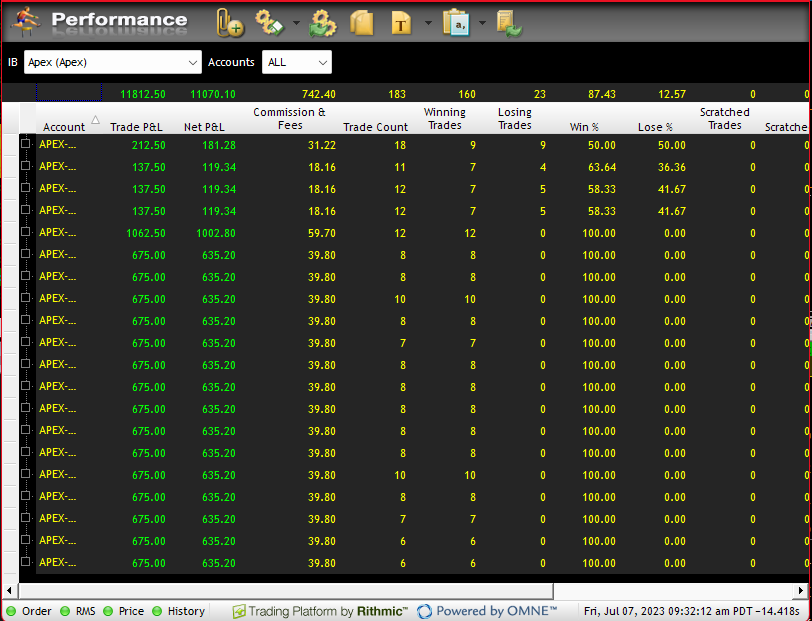
One of the most unique features Apex offers is the ability to trade up to 20 accounts at once. That means if you’ve passed multiple evaluations or have multiple live accounts, you can execute a single trade and have it copy across all of them automatically.
For example, if you take a $300 winning trade and you’re trading 20 PA accounts simultaneously, that same setup could net you $6,000 in total profits, all from one small trade.
Many participants in our trading community routinely utilize a trade copier to scale their market exposure seamlessly. If your goal is to manage multiple allocations efficiently, utilizing the native tools inside the WealthCharts or Tradovate software ecosystems is the cleanest path, as both platforms support multi-account mirroring right out of the box without requiring external software installations.
If your intention is to copy trade across multiple accounts, Wealthcharts and Tradovate are good trading platform options as its built specifically for that with no external software required.
Best Practices to Pass Your Apex Evaluation
Successfully navigating the evaluation phase requires balancing baseline trading skills with disciplined execution parameters. Use these straightforward trading guidelines to enhance your consistency, stay within the rules, and secure your funded profile:
- Preserve Your Capital Cushion: Employ proper risk-to-reward metrics on every setup. Emphasize capital preservation and avoid scaling into maximum contract sizes, especially near major macroeconomic data releases.
- Maintain Behavioral Discretion: Display uniform execution habits and consistent trading performance throughout your evaluation period. Treat the evaluation profile like a real live funded balance from day one.
- Adhere to Program Guidelines: Avoid unnecessary risks or complex strategies that push your limits. Focus on hitting steady gains rather than gambling your chips on a single trade for a big score.
- Flatten Before the Close: Monitor the clock closely. Failing to fully liquidate all working orders and open positions prior to the mandatory 4:49 PM EST market break triggers an immediate automated failure rule.
My Experience with Apex Trader Funding
I've personally passed numerous Apex evaluations, traded both their $50K and $100K Performance Accounts, and received consistent payouts. Although I primarily trade through my own brokerage accounts these days, my experience with Apex has been positive, and I recommend all new futures traders (even if experienced in stocks) to begin with this program to limit their risk substantially and learn how to get paid in futures before risking significant funds in a direct brokerage.
One thing I've learned from years of trading and mentoring other traders is that affordable evaluations can be both a blessing and a curse. When accounts cost so little during promotions, it's tempting to take excessive risks, blow an account, and simply purchase another one. But those costs add up quickly, especially when trading multiple accounts.
My advice? Treat your Apex account with the same discipline you would your own money. Trade small, wait for quality setups, and focus on building consistency rather than rushing to pass an evaluation. For traders willing to take that approach, I genuinely believe Apex offers a valuable opportunity to develop their skills and earn payouts without committing substantial personal trading capital.
The Verdict: Is Apex Trader Funding Worth It?
Apex Trader Funding remains one of the premier choices in the futures prop firm space for a reason. By offering massive purchasing power, capping your downside to affordable entry fees, and removing strict daily consistency rules on standard evaluations, they provide an incredibly fair path to securing real market funding.
If you are a disciplined trader who can manage a trailing threshold, the End-of-Day (EOD) accounts offer the best operational environment to scale your trading business up to 20 accounts simultaneously.
Ready to select your evaluation size? Use coupon code: LIVESTREAM at checkout to secure the highest active promotional discount currently provided by the firm.